
Showing posts with label fishing. Show all posts
Showing posts with label fishing. Show all posts
Friday, January 30, 2015
Smallmouth location


Friday, January 25, 2013
Lure selection for the Little Miami River
I think that one reason river fishermen dont painstakingly match the hatch with exact copies of the forage that bass eat is that rivers are so daggone complicated. In the LMR over a hundred different species of fish have been recorded and most of them are small fishes that could serve as bass food. And the abundance of these can vary wildly over the 110 mile plus length of the river. But since the Little Miami is designated a National Wild and Scenic River it has been studied rather extensively. Sampling surveys over the years have shown definate trends that can help you with your lure selection depending on where you are fishing in the river. Many minnow species like the central stoneroller and the various darters and shiners are found throughout the river but the population densities of each are different in different sections of river. In the lower LMR, say from Loveland/Milford to the Ohio River, shiner species such as the emerald shiner greatly outnumber other small fishes. So what does this mean? Well, shiners have a completely different shape and profile than other small fishes. They are long with a thin profile and look slightly flat being taller than they are across and silvery in color. In other words alot like classic floater diver minnow plugs such as the Rapala or AC Shiner. In the lower river you might want to fish soft plastics with this profile too such as the Mister Twister Sassy Shad. Shiners also spend alot of time in open water and close to the surface so topwaters like the pop-r are also great where shiners are common. Also the closer to the Ohio the more shad you will find. In the middle reaches of the LMR you begin to find higher and higher numbers of darters in every survey till they become the most common small fishes found on some stretches. Darters are very very colorful and on average smaller than shiner species. Darters also spend most of their time under and around rocks in swifter sections of the river. This is why rock cover becomes more important as you progress upstream and sandy gravely cover less so. Also riffles produce better in the middle LMR than the upper or lower LMR. Lures in brighter patterns with a bit of red or orange produce well in the middle LMR. Instead of a silver rapala like you threw in the lower LMR, a slightly rounder bait like a smaller rebel minnow in a "rainbow trout" pattern might be a better place to start. At the top of the middle LMR, say from Fort Ancient to the Narrows, the number of darters and shiners equals out somewhat with more plain minnows like the stoneroller than anything else. Here it becomes an anything goes affair dependant more on where you are fishing, a riffle might be full of darters but next to a pool with shiners, chubs and minnows in it. In this stretch carrying a wide lure selection can really pay off. Further upstream the river becomes a minnow factory with high numbers of darters and minnows such as the stoneroller. In some pools the number of stonerollers is staggering, well into the thousands. Here generic minnow lures like inline spinners and metalflake grubs really shine. These are just general guidelines and you might find smallies feeding on darters in the lower LMR and on shiners in the middle LMR but it gives you somewhere to start. The particular spot you are fishing is just as important as the section of river. If your fishing a riffle you might want to fish a bottom hugging smaller brighter lure while a bigger silvery plug might be the ticket in a big pool.
Some common small fishes of the LMR...
Central Stoneroller
The most common small fish in the LMR, Stonerollers are stout brownish gray minnows with short, rounded fins. The snout is bluntly rounded and projects beyond the nearly horizontal mouth. Their mouth is always white in color. Males during breeding season have some orange and black on fins, large pointed bumbs on their head, and orange eyes.
Stonerollers spawn in spring between March and the end of May. Males dig spawning beds just above or below riffles and aggressively chase other males away. The eggs are sticky and become lodged in the gravel and the nests abandoned prior to hatching. While they can reach seven inches most stonerollers are around three or four inches in length. Stonerollers feed by scraping algae from rocks on the riverbottom. The LMR is also home to other minnow species such as the tonguetied, suckermouthed, bluntnosed, fathead, and bullhead minnows. These are some of the most common small fishes in the pools of the river.
Shiners
The LMR is home to something like fifteen or sixteen different species of shiners. Shiners typically have a long thin profile and look slightly flat being taller than they are across. Shiners as a whole tend to hang out in open water like pools and often high in the water column. Shiners typically eat tiny insects and other various aquatic invertebrates, and terrestrial insects that fall in the water or fly just above the surface. Often when it is still and wind is not blowing you can see them dimpling the surface feeding on tiny insects like midges. Most shiners are three to five inches long but a few can reach up to ten inches in length.
Darters
The LMR is home to around a dozen different species of darters. Darters run two to four inches in length for the most part and are among the most colorfull fish you will ever see. When breeding most darters become very bright with fins edged in orange or red and bright blues as well as spots or bands of bright colors on their bodies. Darter species on the LMR include the greenside, rainbow, fantail, least, johnny, and orangethroat darters as well as the logperch, varigate, banded, channel, blackside and slenderhead darters plus maybe an additional one or two that I may be missing. Most darters inhabit swifter riffles in the LMR often hiding under flat rocks in the swift current. Darters eat mostly small crustaceans and aquatic insect larvae.
Sculpins and Madtoms
The LMR is home to five species of madtoms as well as the mottled sculpin. Like the darters these guys spend most of their time glued to the bottom of swifter riffles and runs or at least right on the edge of such places. Ferocious predators they are almost like tiny three to five or six inch long shovelheads, eating whatever they can fit in their mouths. More camoflaged than darters they are usually colored to blend in with their surroundings.
Chubs
The LMR has around seven or eight species of chubs. Chubs mostly have a thich rounded body and can grow fairly large, up to a foot in some species though most are around five or six inches in length. Chubs eat small invertabrates and insects but large ones can even take small crayfish. Chubs grow big enough to be caught on hook and line and are often caught as shovelhead bait.
I almost dont want to get into crayfish because I'm going to part ways with 95% of you on this. First off they are very important as smallie food. So important its almost impossible to overstate their importance. That being said heres why I hardly ever imitate them! Even though I'm constantly fishing for smallmouth that are feeding on them. First off, pick a day in June. Then there are really only two sizes of crayfish in the river as far as a smallmouth is concerned. Great big ones left over from previous years and ones hatched this year. The old ones may vary in size but to a smallmouth they are all the same size...too damn big. Every study I've seen says that smallmouth are constantly selecting small crayfish and leaving the big ones alone. Or if they take a big one they circle around it a while or pick it up and blow it out several times till they get it facing tail first. Several studies suggest that the very biggest smallmouth are the most selective for size. Ok so that leaves me that years crayfish. In midsummer that years crayfish reach a size that smallmouth love. In one study in Wisconsin crayfish were 14 percent of food volume in May but a whopping 83 percent from July to September. So after July if you catch a smallie he's probably looking for a craw. So heres my problem. Smallmouth arent selective about minnows in the LMR, they come in all shapes, colors, and sizes so they cant key completely on just one. But young of the year craws are all the same size, the same color, almost exactly. And this size changes constantly. In their first year crayfish molt something like ten or eleven times because they are growing so fast. So every craw looks the same, is the same shade at the same time in that hole and every smallmouth knows it. So I cop out. If a smallmouth is nosing around looking for a craw and a tasty minnow imitation like a three inch grub swims along he's not going to pass it by.
Ok so why is the rebel craw such a great lure?
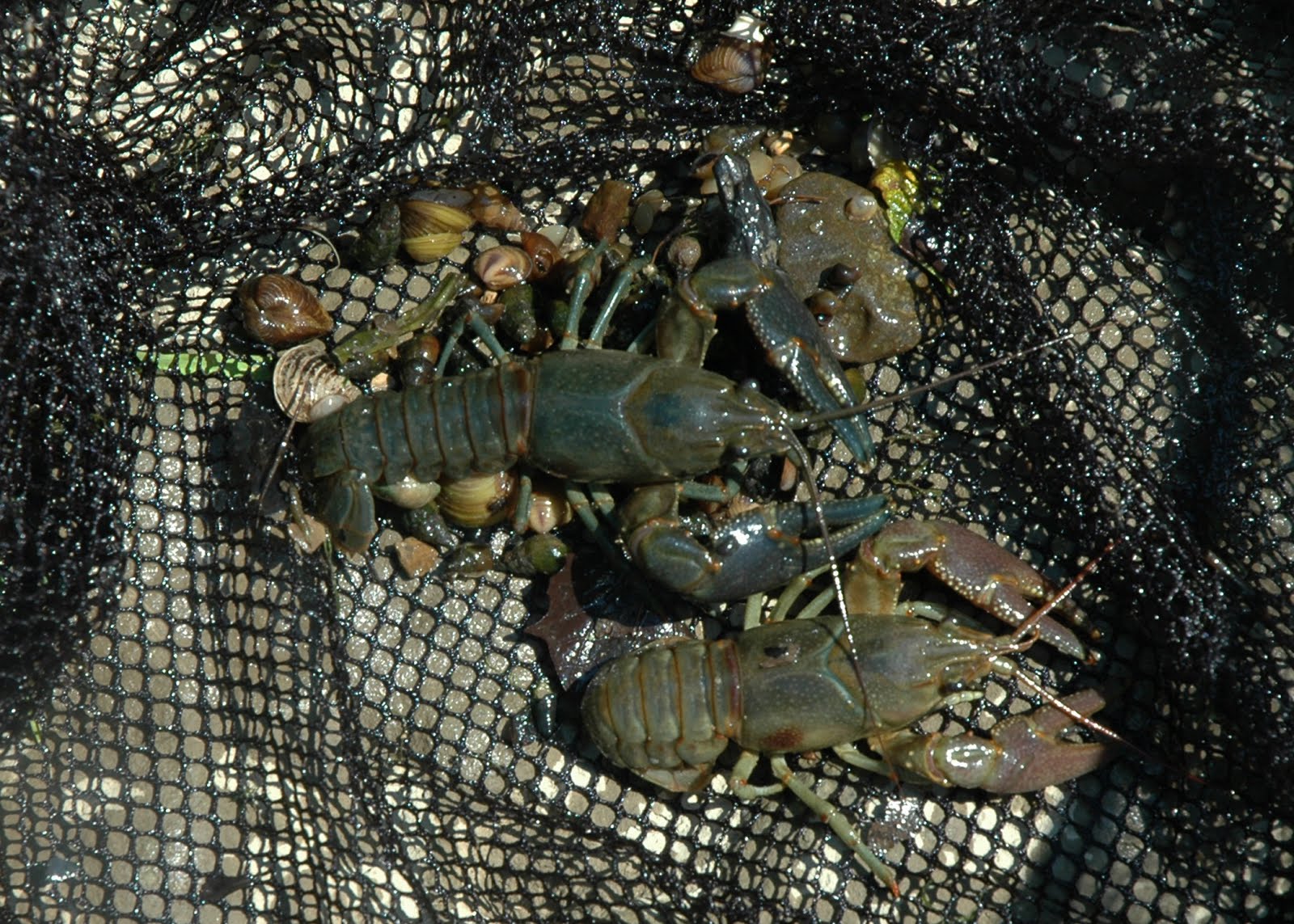
Look at these two pictures...
 Big craws out of the LMR
 Little craw out of the LMR
Now lets be honest does a rebel craw look anything like either one of those?
Does it act like them?
I think a rebel craw is a crankbait that is just the right size for catching alot of fish in the river and it doesn't run too deep like something like a model A bomber does. It wobbles along at a good depth to fish below and above riffles and its a good size so it catches fish. Heck I fish one alot. I just dont really think I'm imitating a crawfish. Its generic fish food I'm imitating.
When I'm bouncing a grub in the rocks or hopping a marabou jig along the bottom or fishing a suspending crankbait just off the bottom, thats when I feel like I'm fishing for smallmouth feeding on craws. Smallmouth are opportunists and theres too many minnow species for them to become selective so I'm not going to throw something like a really detailed plastic craw at them because thats the one and only thing in the river they just might be selective about. He might hit my big living rubber jig with a plastic craw trailer but he's going to really look it over and he might be just a bit afraid of it and suck it in and blow it out a couple times first but the same fish is going to confidently swim over and thump my smoke metalflake grub without a second thought. Like I said I'm going against the grain here but I dont try to imitate craws in the LMR when lure fishing. I think alot of the small dark jigs like marabou jigs or little living rubber jigs or even wooleybuggers the bass thinks is something else yummy like a hellgrammite in addition to a craw. The nice thing about fishing is people can look at things completely differently and both still be right some of the time.
__________________
__________________
Little craw out of the LMR
Now lets be honest does a rebel craw look anything like either one of those?
Does it act like them?
I think a rebel craw is a crankbait that is just the right size for catching alot of fish in the river and it doesn't run too deep like something like a model A bomber does. It wobbles along at a good depth to fish below and above riffles and its a good size so it catches fish. Heck I fish one alot. I just dont really think I'm imitating a crawfish. Its generic fish food I'm imitating.
When I'm bouncing a grub in the rocks or hopping a marabou jig along the bottom or fishing a suspending crankbait just off the bottom, thats when I feel like I'm fishing for smallmouth feeding on craws. Smallmouth are opportunists and theres too many minnow species for them to become selective so I'm not going to throw something like a really detailed plastic craw at them because thats the one and only thing in the river they just might be selective about. He might hit my big living rubber jig with a plastic craw trailer but he's going to really look it over and he might be just a bit afraid of it and suck it in and blow it out a couple times first but the same fish is going to confidently swim over and thump my smoke metalflake grub without a second thought. Like I said I'm going against the grain here but I dont try to imitate craws in the LMR when lure fishing. I think alot of the small dark jigs like marabou jigs or little living rubber jigs or even wooleybuggers the bass thinks is something else yummy like a hellgrammite in addition to a craw. The nice thing about fishing is people can look at things completely differently and both still be right some of the time.
__________________
__________________

Friday, December 28, 2012
Running out of time
With snow in the forcast for the weekend and time running out to sneak in one last trip this year, I headed out right after work to the Great Miami. Bundled up in insulated coveralls with a heavy jacket on top it wasn't bad at all.

 I fished the last bit of daylight which was cool because all the ducks and geese were coming back to the river for the night and were pretty noisy in the still evening air. Plus a couple ring billed gulls were cruising up and down the river. Caught two sauger, both on a hot pink and metalflake three inch grub on a 1/4 ounce jighead. Both strikes came on casts straight out as I let the jig sweep downstream on a tight line. River was in good shape. Didn't see anyone else fishing and had the river to myself, nice little trip.
__________________
I fished the last bit of daylight which was cool because all the ducks and geese were coming back to the river for the night and were pretty noisy in the still evening air. Plus a couple ring billed gulls were cruising up and down the river. Caught two sauger, both on a hot pink and metalflake three inch grub on a 1/4 ounce jighead. Both strikes came on casts straight out as I let the jig sweep downstream on a tight line. River was in good shape. Didn't see anyone else fishing and had the river to myself, nice little trip.
__________________


Friday, September 7, 2012
A douple dip of paying dues...
AT first light my brother let me out about five miles from the truck. In between was all lovely woods, hopefully full of ginseng. Five hours later I staggered out of the woods with five paltry ginseng plants. This woods had taken the full brunt of the drought. All the plants Id found were just about gone and dried up. Two I found only because there was red berries on a bare stalk. No leaves at all.
 deciding to try and salvage the day I decided to go fishing at the site of the old kings dam. On the way down the bike trail I saw several deer and two wild turkeys. So I'm thinking hey thats a good start, its going to be a great evening. I get down to the river and wade in. Right away I catch a smallie and as I'm unhooking it I hear a deer blow behind me. I turn and see two deer bounding away from the rivers edge. Yep it's going to be a great evening... way away in the distance I can hear a storm. I'm thinking that sounds like its going around, should be just close enough to cool things down nicely. Just then the wind began to blow a bit as I made a few more casts. About that time lightning struck so close I just about jumped out of my skin. Two minutes later all the leaves were just about ripped from the trees as the wind hit hard. With the wind came more lightning. And rain. Buckets of rain. big buckets of rain. I backed up against a pile of rubble from the old dam to hunker down and wait things out. OK this will really turn the fish on after all this dry weather. Sure enough as I sat there I swear I saw fish swirling below the riffle between sheets of rain. But more flashes and thunder booming all around. Im ok with fishing in the rain but not lightning... So I sat getting wetter and wetter as it rained harder. Thru the heavy rain I could see the river coming up just a bit and coloring a little. Then poof no more rain. Even the sun began to peak out from behind the clouds. But across the hole I could see huge streaks of muddy orange water as runoff poured into the river. Ok I've got a vibrating crankbait with a rattle this will be ok. But withen minutes the whole river was orange and worse the storm had washed every leaf in the state into my section of river, you couldn't retrieve two feet without fouling on leaves. So driving home soaking wet and defeated I took the senic route home and drove upstream. Halls creek which had been dry yesterday was waist deep and going fast enough to drown in. All the way to Todds Fork the river was a mess. Crossing the bridge in Morrow looking upstream the river was beautifull. I bet the fishing was really something up there tonight...

deciding to try and salvage the day I decided to go fishing at the site of the old kings dam. On the way down the bike trail I saw several deer and two wild turkeys. So I'm thinking hey thats a good start, its going to be a great evening. I get down to the river and wade in. Right away I catch a smallie and as I'm unhooking it I hear a deer blow behind me. I turn and see two deer bounding away from the rivers edge. Yep it's going to be a great evening... way away in the distance I can hear a storm. I'm thinking that sounds like its going around, should be just close enough to cool things down nicely. Just then the wind began to blow a bit as I made a few more casts. About that time lightning struck so close I just about jumped out of my skin. Two minutes later all the leaves were just about ripped from the trees as the wind hit hard. With the wind came more lightning. And rain. Buckets of rain. big buckets of rain. I backed up against a pile of rubble from the old dam to hunker down and wait things out. OK this will really turn the fish on after all this dry weather. Sure enough as I sat there I swear I saw fish swirling below the riffle between sheets of rain. But more flashes and thunder booming all around. Im ok with fishing in the rain but not lightning... So I sat getting wetter and wetter as it rained harder. Thru the heavy rain I could see the river coming up just a bit and coloring a little. Then poof no more rain. Even the sun began to peak out from behind the clouds. But across the hole I could see huge streaks of muddy orange water as runoff poured into the river. Ok I've got a vibrating crankbait with a rattle this will be ok. But withen minutes the whole river was orange and worse the storm had washed every leaf in the state into my section of river, you couldn't retrieve two feet without fouling on leaves. So driving home soaking wet and defeated I took the senic route home and drove upstream. Halls creek which had been dry yesterday was waist deep and going fast enough to drown in. All the way to Todds Fork the river was a mess. Crossing the bridge in Morrow looking upstream the river was beautifull. I bet the fishing was really something up there tonight...
Saturday, August 20, 2011
River mist


Sometimes the river is so lovely, the light falling softly on the water or the mist creating an air of mystery, that I forget why I'm there. The fishing lost in birdsong and the sound of the water in the riffle. Last night was one of those nights. Oh I caught fish, for a few minutes smallmouth came almost every cast, right at dark stacked up in an eddy below a fast run. But what I'll take away most from tonight was a basswood leaf looking like nothing more than a broken heart drowning in the water. And walking down to the water, the buck that walked out into the field and then jumped when he saw me, reminding me of how when you walk right up on someone and they turn and jump out of their skin when they see you. It's hard for even a buck to keep his dignity when frightened that badly.

I looked around at the last minute and couldn't find anything I wanted to take with me to eat so I stuffed a half empty bag of marshmallows in the pack and feasted, feeling like a little kid roasting them over a twig fire on the riverbank. A beautiful fog came with the night slowly covering the river in a soft blanket for the night.


I fished live bait on the big baitcaster. A small drum about the size of my hand, hoping for a big shovelhead. Sometime in the middle of the night a fish took it but then let it go. On the other rod I fished nightcrawlers and fared much better. A sauger, three drum, and two small catfish. And a big carp, not a giant, but big enough that his tail flopped over out of the landing net.


Saturday, May 7, 2011
Shul

Shul in Tibetan is defined as "an impression: a mark that remains after that which made it has passed by; a footprint, for example. Shul is used to describe the scarred hollow in the ground where a house once stood, the channel worn through rock where a river runs in flood, the indentation in the grass where an animal slept last night, the torn ruins of a lost civilization. All these are shul: the impression of something that used to be there."
There's this place I go to fish, go to get away from it all that always brings this word to mind. It's a lake made from an old rock quarry. Set in a beautiful but desolate setting, the lake seems natural, like it has always been there, part of the landscape. Like the way Machu Picchu or an old lighthouse becomes the landscape in the way a metal pole barn or a cell tower can never be. The "impression" of the old quarry, just a big empty place a mile from the road.

The same word Shul in Yiddish means temple and for me this also fits. A temple in the way John Muir saw nature as a temple. John Muir said the clearest way into the universe is through a forest wilderness. Among the dark pines on the hill overlooking the lake I am far more likely to set for a bit and ponder whether or not I've lived a good life than I've ever been prone to do in a man made church. I'm also just as likely, here away from distraction, to spend an hour trying lure after lure trying to unlock the secrets to the lakes fishing. But maybe thats right too, in the way zen teaches us how we can learn to live our lives well by paying real full attention to each task we do, to Live each momment in the now. Or maybe I'm just an old sentimental fool trying to find meaning in a pretty place just because I love it.
The secret this last trip lay with a rebel minnow plug. The first three casts netted three fish. On the first cast a fish struck and I said aloud to myself, "Well, there's one", and then "well, there's two" and so found myself doing something I allmost never do, which is count how many fish I caught. This place has always been generous with fish and I knew I caught alot here. But I try to make a pointed effort to not count. How is catching eleven fish less somehow than catching twelve? The image of tournament bass fishing as shown on TV has always been distasteful to me, and I found a fascination in just how caught up in the numbers I became as the mornings fishing went on. It wasn't just a bass, it was number twenty two or twenty six instead of the fish that so hit so hard by the log or the bass that jumped twice. Later someone asked me how I did and I said "I caught Thirty One" and realised I'd learned a lesson, that obsessing on numbers, how many, how big, can take something away from a trip, at least for me. I'd taken my place of refuge, my "shul" and turned it into something else. Something less than wind in treetops, less the play of morning light on the water, less than the excitement of the strike or the shrill cry of a hawk overhead. But I'd come and found out something about myself and why I fish, why I like it here so much where I'm almost always alone, fishing with just the sky and the pines as witness.


Friday, March 18, 2011
The Narrows


Located in Greene County, the Narrows Preserve is one of my most favorite spots anywhere. I didn't mean anywhere along the river, I meant anywhere. Here the glacier pushed the river out of it's bed and the river cut this valley in forming a new one.
The Narrows is a long skinny park and a wide level trail offers excellant access to the river. Just above the park the river twists and turns away from the road and offers some great fishing to anyone willing to bushwack. Downstream in the park there are some of the finest trees you will ever see with huge sycamores hundreds of years old lining the river. About a half mile downstream of the parking lot two huge trees, one on each side of the river, are strong candidates to be the biggest tree in the whole watershed.


The lower half of the park is a great place early and late in the day to spot wildlife such as deer, though on nice evenings the trail fills up with hikers. The big trees draw piliated woodpeckers and the park is a bird watchers delight. Early one spring I heard rustling leaves and stepped off the trail along this lower stretch to investigate and found a half dozen garter snakes just out from hibernation. One of the best looks I've ever had of a mink was also here in the Narrows. The mink foraged along the riverbank, coming within ten feet of me before realizing I was an awfully funny looking tree and bounding off.


There is quite a bit of beaver sign in the parks lower half. Walking the trail quietly right after daylight and watching the river is a good way to spot these giant rodents. I've also been startled by beaver slapping their tails in alarm when they spotted me first.


At about a mile and a quarter from the trail head the river turns creating a long riffle/run/riffle called Brenda's Riffle that offers some of the best fishing in the river's upper half. A lovely creek enters the river here too and a primitive campsite (permit only) located nearby is a great base to spend a long weekend exploring the river and surrounding woods.


Saturday, February 12, 2011
A pocket full of fun...
I often can't sleep at night, a product of years spent working the late shift I guess. I'll turn on the Outdoor Channel and watch those guys dressed like Nascar drivers fishing exotic locations with $30,000 bass boats loaded down with more gear than my father's old bait shop had stocked on the shelves. And that kind of fishing is fun, I admit it. I have hundreds of lures and thousands of flies and dozens of rod and reel combos and have been known to head out looking like I'm heading down the Congo for a month instead of fishing the Little Miami for a couple hours. But do you really need all that junk to have a quality fishing trip? Of course not. You can have a great trip, possibly the best trip of the year and fit everything you need in a shirt pocket. You really only need three or four basic pieces of terminal tackle to catch fish almost every single time you fish a river like the Little Miami. First off get a pack or two of baitholder hooks in size two or four. You can substitute a similar sized hook of another style but baitholders are available almost everywhere and work great. You might want to add a pack of treble hooks in size eight too. Next get a pack of barrel swivels or two and some egg sinkers and your set. Rigging is simplicity itself. The egg sinker is slid onto the line and a barrel swivel is tied into the line about a foot down from the hook. This is idealy fished on a medium spinning outfit and six or eight pound test line. The rig is then tossed out, the rod set in a forked stick and a pebble from the riverbank placed on the line so you can leave the bail open without the line being carried away by the current. More than the tackle the key to catching at least some fish every trip depends on location. Where you want to set up is in a well defined hole just below a nice riffle. Right where the current first begins to slow. If there is an eddy and a deep pocket even better. Too many people fishing bait in the river just set up in the middle of a long slow hole away from the riffle, cover, or the main current. Most of the time this is a recipe for catching little or nothing. Thread on a nightcrawler and fish below a good riffle and you might catch just about anything in the river from all the catfish species, to the occasional bass or carp. In addition nowdays you are just about guaranteed to catch a drum or two (or ten). Any time the water temperature rises above the upper fifties a nightcrawler on light line just about guarantees some drum. Switch to minnows and you might just catch a nice sauger, white bass, or flathead. Baiting up with crayfish in the two or three inch range can also catch just about anything that swims. Change the baitholder out with the treble hook and bait up with a doughball made of wheaties and hamburger and your set for channel cats and carp. Trust me catching a half dozen five or six pound carp on light spinning tackle will change the way you look at these guys forever.
I must admit my favorite way to fish the river is wading the river casting for smallmouth bass with lures but even on these trips I often throw a dozen nightcrawlers in the daypack. About midday I'm ready for a break and stop at a nice riffle and throw this rig out while I eat a sandwich. It's amazing just how often this "break" produces the most memorable fish of the day...

I must admit my favorite way to fish the river is wading the river casting for smallmouth bass with lures but even on these trips I often throw a dozen nightcrawlers in the daypack. About midday I'm ready for a break and stop at a nice riffle and throw this rig out while I eat a sandwich. It's amazing just how often this "break" produces the most memorable fish of the day...
Friday, December 3, 2010
Loveland


To my eyes, Loveland may be the prettiest town on the whole river. It is at least the one who's made the biggest attempt to embrace it's heritage as a river town. Indeed even though the bikeway runs the length of the river, Ive heard several people refer to it as the Loveland bike path. And no wonder, here, restaurants, ice cream shops, bike shops, coffee and tea shops, and the LMI Scenic River & Trail Center line the trail thru town. Right in town at the mouth of Obannon Creek may not be the best place to start your fishing adventures on the Little Miami. Not because it's not fishy looking but because it's crawling with kids wading, dog's fetching, and people just generally enjoying the river. Upstream at the first riffle before the really deep water will allways be special to me, for here I lost the biggest smallmouth I've ever hooked. It was late fall when the bass hit a grub and jumped clean out of the water giving me a good look at it's size. I had the big bass on long enough to be sure I was going to land it when the line just went slack. No theatrics just a slack line and no fish. A few kids were watching from downstream and it was all I could do not to throw a mini hissyfit in midstream. Not that it would have helped any. I won't say what I thought the bass weighed so I won't be called a liar, let's just call it very large.
Loveland is named after James Loveland, who ran a store and post office near the railroad tracks downtown. Loveland was promoted by the railroad as a resort town, who gave it the nickname "Little Switzerland of the Miami Valley." In the 1920s, The Cincinnati Enquirer ran a promotion that offered a free plot of land in Loveland, along the Little Miami River, after paying for a one-year subscription to the paper!
Some of the most graphic photos of the horrific 1913 flood that exist are of Loveland.


Even the bridges over the river in town are decorated with flowers.


Much of the riverbank in town is one big park.


The remains of an old dam across Obannon creek just upstream from the river.


Looking up the creek from the river towards an old rail bridge that carries the bikeway across the creek.


Subscribe to:
Posts (Atom)