Here we have the site of an old dam that has been washed out. There are literally hundreds of these on Midwestern rivers and streams. Many powered old mills or factories around the turn of the century. Spots marked A are smaller pieces of rubble in the fast water that are only big enough to hold a single fish. In the swift water pouring thru the breach in the dam these spots can be hard to find. But potentially they hold some great fish and are worth search for. A swimbait or grub on a heavy jighead to get it down works great here. Often cast cross current and slightly upstream and letting the lure sweep down on a tight line is best. Spots marked B are bigger pieces of rubble fronm the old dam and can hold multiple fish. If they are undercut or naturally contain holes or pockets they can hold some big shovelhead as well. One thing to remember is that sometimes this is another spot where casting close to or even hitting the object with your lure can pay big dividends. Sauger sometimes also hold on this kind of place just not as closely as the smallmouth. Most old dams are undercut as at spot C if there is current flowing against the undercut it can hold nice smallies. These undercuts are also great places for a big shovelhead as well. Spot D is the bar formed by the downstream lip of the old dam when it was whole. This fishes like any other riffle but has the added benefit of being close to the deep water around the old dam. Expect some nice fish to be on this riffle at low light.
Ohio outdoors, photography, fishing, hiking etc. Visit my website at www.stevenoutside.com
Showing posts with label darters. Show all posts
Friday, January 30, 2015
Even more smallmouth locations
Here we have the site of an old dam that has been washed out. There are literally hundreds of these on Midwestern rivers and streams. Many powered old mills or factories around the turn of the century. Spots marked A are smaller pieces of rubble in the fast water that are only big enough to hold a single fish. In the swift water pouring thru the breach in the dam these spots can be hard to find. But potentially they hold some great fish and are worth search for. A swimbait or grub on a heavy jighead to get it down works great here. Often cast cross current and slightly upstream and letting the lure sweep down on a tight line is best. Spots marked B are bigger pieces of rubble fronm the old dam and can hold multiple fish. If they are undercut or naturally contain holes or pockets they can hold some big shovelhead as well. One thing to remember is that sometimes this is another spot where casting close to or even hitting the object with your lure can pay big dividends. Sauger sometimes also hold on this kind of place just not as closely as the smallmouth. Most old dams are undercut as at spot C if there is current flowing against the undercut it can hold nice smallies. These undercuts are also great places for a big shovelhead as well. Spot D is the bar formed by the downstream lip of the old dam when it was whole. This fishes like any other riffle but has the added benefit of being close to the deep water around the old dam. Expect some nice fish to be on this riffle at low light.
Sunday, January 25, 2015
Low head Dam Fishing
All that being said, low head dams are also often among the best places to fish on any stream that has them. You can find large numbers of schooling baitfish like shad, shiners and even skipjacks if you are close to a big river like the Ohio River. In other words lots of food for gamefish. Plus current, gravel, rock, concrete. oxygenated water full of eddies and seams. Dams are just all around great places to fish. So let's talk a bit about how to fish them. Most low head dams are not just a wall in the river. Instead the water falls in two steps to dissipate the water's energy and keep it from digging the river bottom out too much. But all that falling water still has lots of power and it does dig out a hole below the dam called a scour hole. It's been m experience that every low head dam also has some sort of undercutting going on as it ages. This can create a hidden home for big fish even a heavily fished dams.
In this drawing you can easily see why such undercutting would be attractive to fish. Overhead cover, oxygen, a strong recirculating current bring food while the fish itself rests in relatively calmer water, what's not to love if your a fish? And 90% of the fishermen who visit the dam don't target the fish tucked up under the dam itself. It's a recipe for a trophy. Below the smallest shallowest dams where it is safe to wade close to the dam, casting a diving crankbait or a sinking or suspending minnow plug along the dam lengthwise can produce great results. Just remember that even tiny low heads can be deadly in times of heavier flows. Below larger dams where it is too deep or too dangerous to wade right next to the dam the current is too strong for most crankbaits to run well. Here a heavily weighted jig head is often your best bet. Other good lures to try are blade baits like silver buddies and tail spinners like the little George. Compact and heavy are the rules here, you want something to cut the current and get down to calmer water under the lip.
Let's expand our look at our low head just a bit. Many low heads have a secondary hydraulic right at the base of the main fall of water. (A) Here you often see carp in the summer trying to make their way up and over the dam. It's been m experience that at most dams this area does not hold many smallmouth bass, at least not sizeable ones. Sometimes though, there are very nice channel cat foraging up here in very swift shallow water that no one seem to target. Casting a bait up onto the dam itself and letting it fall into this area can produce some unlikely but exciting catfish catches.
Then we have our undercut we just talked about (C). Just blow this is the main hydraulic or circulating current. I've seen shovelheads, channels, smallmouth and hybrid stripers high in water column here if large schools of baitfish are present. Below this boil a calmer current flows along the holes bottom. On a big dam you might find blue cats here as well as saugeye holding up during the day. Too often though this area is devoid of cover and not the best place to fish. Oddly enough this is the most fished part of the dam. Lastly we have the lip where the scour hole ends. Often there are gravel and rock bars thrown up here even to the point of forming small islands in the river. These create lots of different seams of conflicting currents that can be fish magnets. These bars often have lots of rock that hold crayfish and darters for gamefish to feed on.
At many older low heads large boulders and concrete rubble have been dumped to control the undercutting of the dam (A). This provides great cover for crayfish, insect life, sculpins, darters and well, lots of smallie food. This is done most often done at older dams that have already been undercut so there are usually nooks and crannies for smallmouth to get into also. If the holes are big enough, and they usually are somewhere along the dam, here is where a big shovelhead will hide during the day also. Over time, during flood events, some of this rock and rubble is naturally washed into the scour hole (B). Now instead of a featureless bowl there is plenty of fish holding structure. And of course some of this also ends up on the bar at the lip of the hole (C). All in all these older dams are some of the most interesting ones to fish and my favorite kind of dam.
It's very important to realize that a fish doesn't interact with it's environment in the 2 D sort of way we do walking on the ground. Instead it see's it's world in a 3 D way much as a bird flying in the air does. Even more so really as the water currents are much stronger than air currents. To a smallmouth a strong seam is an object as real as a building. Low head dams produce all sorts of currents too many to discuss really. Just remember that smallmouth love edges. Anywhere you see an edge, a seam where faster and slower water meet is worth trying below a low head. Often on at least one side or the other below a dam eddies or other respites from the current exist (C). These can be large swirling eddies as big as a house where the dam meets the bank or smaller individual ones created by concrete rubble dumped to prevent bank erosion. Again either way they produce edges where faster and slower water meet. Our undercuts (A) that we already discussed can also channel the water flowing over the dam and create seams all along the dam face. Keep an eye out for pockets of foam just sitting there indicating a calm spot in the turbulent boil below the dam. Likewise the bars formed at the scour holes end (B) are not uniform and create chutes of faster and slower water as well as water channeled sideways across the river. These chutes can create channels down below the dam for quite a ways (D) that if deep enough can hold lots of fish. If there is a theme throughout this whole discussion, it is to spot the edges. When you first look below a dam is just seems a huge mass of disorder and chaos. Slow down a minute and look at pieces of the water. Find calm spots, edges, seams. The longer and closer you look the more it will all "slow down" and begin to make a bit more sense to you. Though complicated and nothing like the "reading the water" we are used to, they are more than worth the time to learn to fish. Just remember each dam is a bit different from every other dam and looking, learning and experimenting are the name of the game.
Sunday, January 18, 2015
Some shiny lil fishes
For a complete list of all fish species in the Great and Little Miami as well as the Whitewater check out this link
http://www.google.com/url?sa=t&rct=j&q=&esrc=s&source=web&cd=5&ved=0CD4QFjAE&url=http%3A%2F%2Foh.water.usgs.gov%2Freports%2Ffishspecies5.pdf&ei=4Hy8VMfvBMSzggTKvISgDQ&usg=AFQjCNHaOqaX2i4xZCMotjgPvLKM83GzNQ&sig2=KfsKpRzWdz58FvGirrQRlA
Here are some highlites of some of my favorites:
Emerald Shiner
The emerald shiner, like most shiners, is laterally compressed, which means they are taller than they are wide. Their sides are a shiny silver color and can also have an emerald green hue. I like to use crystal flash when tying jigs or flies to imitate shiners because of their metallic shiney sheen. Emerald shiners are broadcast spawners which is a fancy way to say they are lousy parents and just spray out eggs willy nilly and give no care to their young. Pool dwellers, they are usually found in open water and stay near the surface. They feed on zooplankton, insect larvae, and small flying insects such as midges.
Spotfin Shiner
Spotfin shiners are one of the two most common minnow species (second only to the bluntnose minnow) found in Ohio. They are solid silver, sometimes with a bluish cast. Spotfins also have, you guessed it, one or two elongated spots on their dorsal fins. Able to thrive in reservoirs, spotfins often inhabit the pools of our streams. They tend to eat a variety of aquatic invertebrates. These guys spawn in crevices between rocks or in bark on limbs of submerged fallen trees.
Chubs
Chubs are one of the most common fish in most streams. They are even abundant in very small trickles where they are often the top predator. They feed on a wide variety of aquatic and terrestrial insect larvae and other invertebrates. Large chubs will even eat small crayfish and fish. Chubs can even be caught on a little piece of worm under a tiny float and many caught this way end up as shovelhead bait. Catching a chub or two is also a byproduct of any trip spent fishing small flies on the fly rod.
http://www.google.com/url?sa=t&rct=j&q=&esrc=s&source=web&cd=5&ved=0CD4QFjAE&url=http%3A%2F%2Foh.water.usgs.gov%2Freports%2Ffishspecies5.pdf&ei=4Hy8VMfvBMSzggTKvISgDQ&usg=AFQjCNHaOqaX2i4xZCMotjgPvLKM83GzNQ&sig2=KfsKpRzWdz58FvGirrQRlA
Here are some highlites of some of my favorites:
Emerald Shiner
The emerald shiner, like most shiners, is laterally compressed, which means they are taller than they are wide. Their sides are a shiny silver color and can also have an emerald green hue. I like to use crystal flash when tying jigs or flies to imitate shiners because of their metallic shiney sheen. Emerald shiners are broadcast spawners which is a fancy way to say they are lousy parents and just spray out eggs willy nilly and give no care to their young. Pool dwellers, they are usually found in open water and stay near the surface. They feed on zooplankton, insect larvae, and small flying insects such as midges.
Spotfin Shiner
Spotfin shiners are one of the two most common minnow species (second only to the bluntnose minnow) found in Ohio. They are solid silver, sometimes with a bluish cast. Spotfins also have, you guessed it, one or two elongated spots on their dorsal fins. Able to thrive in reservoirs, spotfins often inhabit the pools of our streams. They tend to eat a variety of aquatic invertebrates. These guys spawn in crevices between rocks or in bark on limbs of submerged fallen trees.
Chubs are one of the most common fish in most streams. They are even abundant in very small trickles where they are often the top predator. They feed on a wide variety of aquatic and terrestrial insect larvae and other invertebrates. Large chubs will even eat small crayfish and fish. Chubs can even be caught on a little piece of worm under a tiny float and many caught this way end up as shovelhead bait. Catching a chub or two is also a byproduct of any trip spent fishing small flies on the fly rod.
Central Stoneroller
One of the most common fish in the smallmouth streams of the Midwest is the central stoneroller. I like to think of central stonerollers as solar batteries for smallmouth. You see central stonerollers are the champions of algae eaters and may consume up to 27 percent of their body weight in algae per day. The algae thru the miracle of photosynthesis converts sunlight into energy. The algae in turn is eaten by stonerollers and then eaten by smallmouth bass. Nice direct line, simple is always better right? Well, except that according to Wikipedia there are over 72,500 algal species worldwide in most recent estimates and maybe more than a 1000 in a single river like the Little Miami. But that's a topic for another day, back to central stonerollers. Central stonerollers have a lower jaw with a flat, shelflike extension used to scrape algae from rocks. Omnivores, central stonerollers eat detritus, animal matter, and terrestrial vegetation besides the algae that makes u almost half of their diet. Adults range in length from 3 to 5 inches, but they can reach 7 inches. Males are generally larger than females.
It takes one to four years for central stonerollers to reach maturity. Breeding males begin building nests in late winter and continue throughout midsummer, creating large, bowl-shaped depressions just upstream or downstream of riffles by rolling stones along the bottom with their noses . Which is where they get the name stonerollers. The males aggressively defend their nests against rival males. Spawning occurs in early spring and summer. Females remain in deeper water outside the nesting site, entering only briefly to produce up to 4800 eggs in a nest. The male fertilizes the eggs, causing them to stick to the gravel of the nest, preventing them from being carried away by the currents.
When it comes to their appearance, it seems every source I find uses the word stout to describe them so I'll go with that that. Stout brownish minnows with breeding males that have some orange and black on their fins, large pointed tubercles (horn like bumps) on their head, and reddish orange eyes.
That's a pretty wild description and also accurate.
It takes one to four years for central stonerollers to reach maturity. Breeding males begin building nests in late winter and continue throughout midsummer, creating large, bowl-shaped depressions just upstream or downstream of riffles by rolling stones along the bottom with their noses . Which is where they get the name stonerollers. The males aggressively defend their nests against rival males. Spawning occurs in early spring and summer. Females remain in deeper water outside the nesting site, entering only briefly to produce up to 4800 eggs in a nest. The male fertilizes the eggs, causing them to stick to the gravel of the nest, preventing them from being carried away by the currents.
When it comes to their appearance, it seems every source I find uses the word stout to describe them so I'll go with that that. Stout brownish minnows with breeding males that have some orange and black on their fins, large pointed tubercles (horn like bumps) on their head, and reddish orange eyes.
That's a pretty wild description and also accurate.
Thursday, January 15, 2015
A little bit about Darters
With winter upon us, I'm trying to bone up a bit on the complicated food chain in our rivers. Today a bit on darters...
Darters are among the most ecologically important fishes found in found in the streams of the midwest. In many sections of stream up to a third of all fish species will be some kind of darter. But most fishermen that wade and fish these same streams know little or nothing about them.
Darters are also an important piece of that big puzzle we are always trying to put together when we are out on the water. So here is a mini primer on these cool little fish.
Each species of darter has evolved to occupy a specific slot or niche in the food chain. That is why there are often several species in the same section of riffle. Some may occupy bigger rocks and rubble than others. Some species may live in more current or shallower or deeper water than other species. In my favorite river, the Little Miami, there are a dozen species alone. Darters prey on insects and crustaceans, and in turn are preyed on by species such as smallmouth bass and saugeye. Darters are an indispensable link in the food chain. The presence of darters in a stream reflects good water quality and diversity of healthy habitats.
A darter is built to maneuver in, around and under rocks and gives it an advantage as a bottom forager. Fast swift riffles provide protection for darters because few predators can live there and must move in and out even if they do forage there. In nature, it is usually true that "form follows function." Many darters do not even possess a swim bladder. This lack of buoyancy allows them to stay near the bottom in swift currents. Many bottom-dwelling darters possess flattened, downward-sloping heads. This feature lets them take advantage of water flowing to help plane or push down on the fish's head, thereby helping the fish to remain near the bottom. Some darter species that live at mid-water depths do possess a swim bladder to help them remain suspended in the water column.
Darters are small. However, there is considerable variation in length among the species found in our rivers, anywhere from an inch or so up to six inches long.
What darters eat varies with the lifestage of the fish. Juvenile darters chomp on small crustaceans such as water fleas, plankton and zooplankton . Adults prefer midge larvae, blackfly larvae, mayflies and caddisflies. Larger darters species may also eat amphipods freshwater shrimp, isopods sowbugs and crayfish. Darters do not compete with most minnow species because the minnows often occupy the upper levels of the water column. Food availability and water velocity help to determine the activity levels of darters' foraging. For example, in pools or areas of slower current, darters range farther to procure food. Similarly, when flow rates are high, travel is reduced. The presence of large crayfish which will prey on darters as well as predatory fish such as smallmouth bass will affect how much darters move also. It turns out that in nature crayfish, while smallmouth prey themselves, benefited from darters being forced to hide underneath the rocks to avoid smallmouth predation. While at the same time the crayfish crawling around hunting in the rocks evicted the darters which made them become more active and available for smallmouth to prey upon. At the same time big darters will eat small crayfish, It is, as the saying goes a fish eat fish world down there.
Photos are from the great ODNR Species Guide Index, a great source on information on all wildlife.
Darters are among the most ecologically important fishes found in found in the streams of the midwest. In many sections of stream up to a third of all fish species will be some kind of darter. But most fishermen that wade and fish these same streams know little or nothing about them.
Darters are also an important piece of that big puzzle we are always trying to put together when we are out on the water. So here is a mini primer on these cool little fish.
Each species of darter has evolved to occupy a specific slot or niche in the food chain. That is why there are often several species in the same section of riffle. Some may occupy bigger rocks and rubble than others. Some species may live in more current or shallower or deeper water than other species. In my favorite river, the Little Miami, there are a dozen species alone. Darters prey on insects and crustaceans, and in turn are preyed on by species such as smallmouth bass and saugeye. Darters are an indispensable link in the food chain. The presence of darters in a stream reflects good water quality and diversity of healthy habitats.
A darter is built to maneuver in, around and under rocks and gives it an advantage as a bottom forager. Fast swift riffles provide protection for darters because few predators can live there and must move in and out even if they do forage there. In nature, it is usually true that "form follows function." Many darters do not even possess a swim bladder. This lack of buoyancy allows them to stay near the bottom in swift currents. Many bottom-dwelling darters possess flattened, downward-sloping heads. This feature lets them take advantage of water flowing to help plane or push down on the fish's head, thereby helping the fish to remain near the bottom. Some darter species that live at mid-water depths do possess a swim bladder to help them remain suspended in the water column.
Darters are small. However, there is considerable variation in length among the species found in our rivers, anywhere from an inch or so up to six inches long.
What darters eat varies with the lifestage of the fish. Juvenile darters chomp on small crustaceans such as water fleas, plankton and zooplankton . Adults prefer midge larvae, blackfly larvae, mayflies and caddisflies. Larger darters species may also eat amphipods freshwater shrimp, isopods sowbugs and crayfish. Darters do not compete with most minnow species because the minnows often occupy the upper levels of the water column. Food availability and water velocity help to determine the activity levels of darters' foraging. For example, in pools or areas of slower current, darters range farther to procure food. Similarly, when flow rates are high, travel is reduced. The presence of large crayfish which will prey on darters as well as predatory fish such as smallmouth bass will affect how much darters move also. It turns out that in nature crayfish, while smallmouth prey themselves, benefited from darters being forced to hide underneath the rocks to avoid smallmouth predation. While at the same time the crayfish crawling around hunting in the rocks evicted the darters which made them become more active and available for smallmouth to prey upon. At the same time big darters will eat small crayfish, It is, as the saying goes a fish eat fish world down there.
Friday, January 25, 2013
Lure selection for the Little Miami River
I think that one reason river fishermen dont painstakingly match the hatch with exact copies of the forage that bass eat is that rivers are so daggone complicated. In the LMR over a hundred different species of fish have been recorded and most of them are small fishes that could serve as bass food. And the abundance of these can vary wildly over the 110 mile plus length of the river. But since the Little Miami is designated a National Wild and Scenic River it has been studied rather extensively. Sampling surveys over the years have shown definate trends that can help you with your lure selection depending on where you are fishing in the river. Many minnow species like the central stoneroller and the various darters and shiners are found throughout the river but the population densities of each are different in different sections of river. In the lower LMR, say from Loveland/Milford to the Ohio River, shiner species such as the emerald shiner greatly outnumber other small fishes. So what does this mean? Well, shiners have a completely different shape and profile than other small fishes. They are long with a thin profile and look slightly flat being taller than they are across and silvery in color. In other words alot like classic floater diver minnow plugs such as the Rapala or AC Shiner. In the lower river you might want to fish soft plastics with this profile too such as the Mister Twister Sassy Shad. Shiners also spend alot of time in open water and close to the surface so topwaters like the pop-r are also great where shiners are common. Also the closer to the Ohio the more shad you will find. In the middle reaches of the LMR you begin to find higher and higher numbers of darters in every survey till they become the most common small fishes found on some stretches. Darters are very very colorful and on average smaller than shiner species. Darters also spend most of their time under and around rocks in swifter sections of the river. This is why rock cover becomes more important as you progress upstream and sandy gravely cover less so. Also riffles produce better in the middle LMR than the upper or lower LMR. Lures in brighter patterns with a bit of red or orange produce well in the middle LMR. Instead of a silver rapala like you threw in the lower LMR, a slightly rounder bait like a smaller rebel minnow in a "rainbow trout" pattern might be a better place to start. At the top of the middle LMR, say from Fort Ancient to the Narrows, the number of darters and shiners equals out somewhat with more plain minnows like the stoneroller than anything else. Here it becomes an anything goes affair dependant more on where you are fishing, a riffle might be full of darters but next to a pool with shiners, chubs and minnows in it. In this stretch carrying a wide lure selection can really pay off. Further upstream the river becomes a minnow factory with high numbers of darters and minnows such as the stoneroller. In some pools the number of stonerollers is staggering, well into the thousands. Here generic minnow lures like inline spinners and metalflake grubs really shine. These are just general guidelines and you might find smallies feeding on darters in the lower LMR and on shiners in the middle LMR but it gives you somewhere to start. The particular spot you are fishing is just as important as the section of river. If your fishing a riffle you might want to fish a bottom hugging smaller brighter lure while a bigger silvery plug might be the ticket in a big pool.
Some common small fishes of the LMR...
Central Stoneroller
The most common small fish in the LMR, Stonerollers are stout brownish gray minnows with short, rounded fins. The snout is bluntly rounded and projects beyond the nearly horizontal mouth. Their mouth is always white in color. Males during breeding season have some orange and black on fins, large pointed bumbs on their head, and orange eyes.
Stonerollers spawn in spring between March and the end of May. Males dig spawning beds just above or below riffles and aggressively chase other males away. The eggs are sticky and become lodged in the gravel and the nests abandoned prior to hatching. While they can reach seven inches most stonerollers are around three or four inches in length. Stonerollers feed by scraping algae from rocks on the riverbottom. The LMR is also home to other minnow species such as the tonguetied, suckermouthed, bluntnosed, fathead, and bullhead minnows. These are some of the most common small fishes in the pools of the river.
Shiners
The LMR is home to something like fifteen or sixteen different species of shiners. Shiners typically have a long thin profile and look slightly flat being taller than they are across. Shiners as a whole tend to hang out in open water like pools and often high in the water column. Shiners typically eat tiny insects and other various aquatic invertebrates, and terrestrial insects that fall in the water or fly just above the surface. Often when it is still and wind is not blowing you can see them dimpling the surface feeding on tiny insects like midges. Most shiners are three to five inches long but a few can reach up to ten inches in length.
Darters
The LMR is home to around a dozen different species of darters. Darters run two to four inches in length for the most part and are among the most colorfull fish you will ever see. When breeding most darters become very bright with fins edged in orange or red and bright blues as well as spots or bands of bright colors on their bodies. Darter species on the LMR include the greenside, rainbow, fantail, least, johnny, and orangethroat darters as well as the logperch, varigate, banded, channel, blackside and slenderhead darters plus maybe an additional one or two that I may be missing. Most darters inhabit swifter riffles in the LMR often hiding under flat rocks in the swift current. Darters eat mostly small crustaceans and aquatic insect larvae.
Sculpins and Madtoms
The LMR is home to five species of madtoms as well as the mottled sculpin. Like the darters these guys spend most of their time glued to the bottom of swifter riffles and runs or at least right on the edge of such places. Ferocious predators they are almost like tiny three to five or six inch long shovelheads, eating whatever they can fit in their mouths. More camoflaged than darters they are usually colored to blend in with their surroundings.
Chubs
The LMR has around seven or eight species of chubs. Chubs mostly have a thich rounded body and can grow fairly large, up to a foot in some species though most are around five or six inches in length. Chubs eat small invertabrates and insects but large ones can even take small crayfish. Chubs grow big enough to be caught on hook and line and are often caught as shovelhead bait.
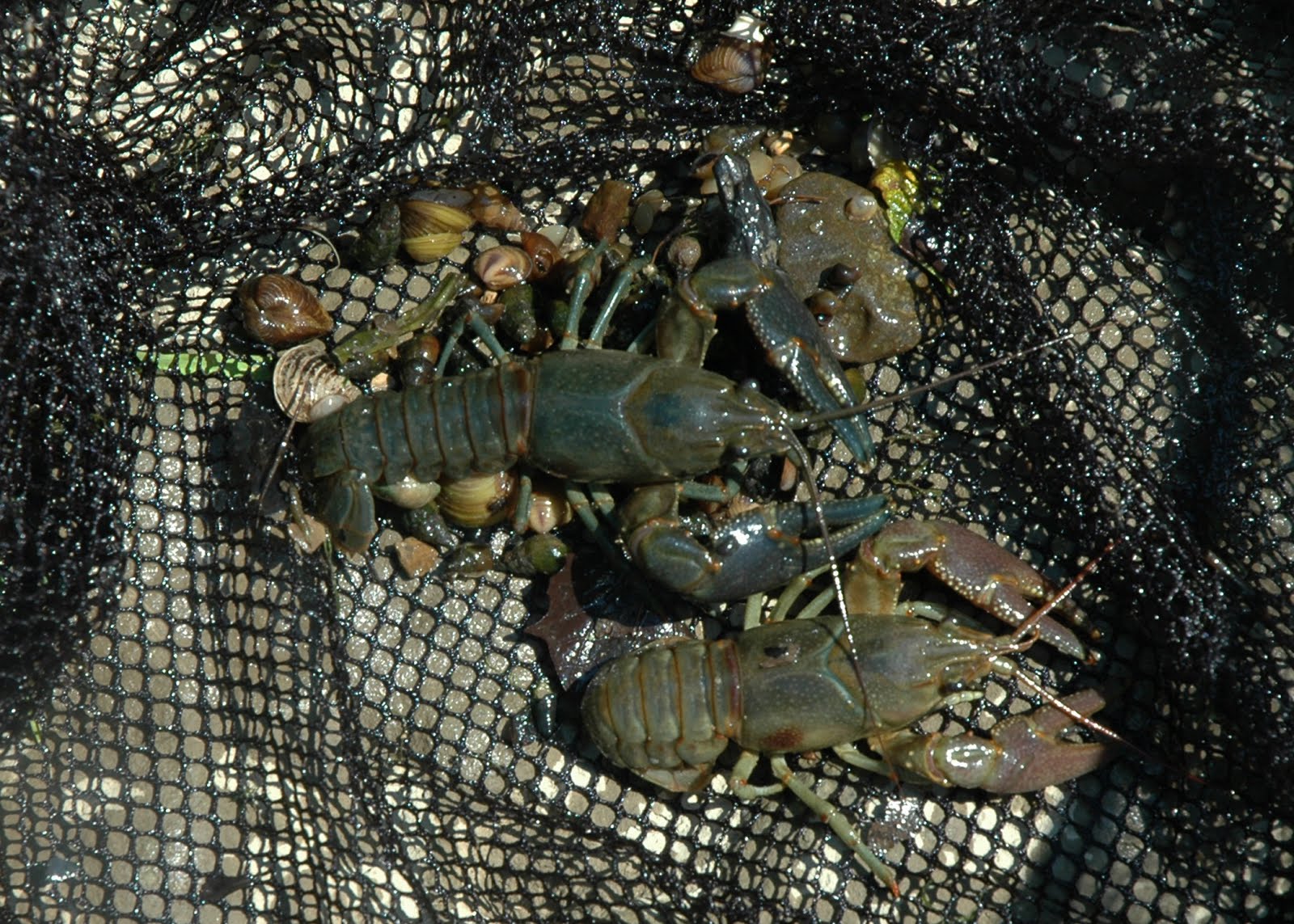
I almost dont want to get into crayfish because I'm going to part ways with 95% of you on this. First off they are very important as smallie food. So important its almost impossible to overstate their importance. That being said heres why I hardly ever imitate them! Even though I'm constantly fishing for smallmouth that are feeding on them. First off, pick a day in June. Then there are really only two sizes of crayfish in the river as far as a smallmouth is concerned. Great big ones left over from previous years and ones hatched this year. The old ones may vary in size but to a smallmouth they are all the same size...too damn big. Every study I've seen says that smallmouth are constantly selecting small crayfish and leaving the big ones alone. Or if they take a big one they circle around it a while or pick it up and blow it out several times till they get it facing tail first. Several studies suggest that the very biggest smallmouth are the most selective for size. Ok so that leaves me that years crayfish. In midsummer that years crayfish reach a size that smallmouth love. In one study in Wisconsin crayfish were 14 percent of food volume in May but a whopping 83 percent from July to September. So after July if you catch a smallie he's probably looking for a craw. So heres my problem. Smallmouth arent selective about minnows in the LMR, they come in all shapes, colors, and sizes so they cant key completely on just one. But young of the year craws are all the same size, the same color, almost exactly. And this size changes constantly. In their first year crayfish molt something like ten or eleven times because they are growing so fast. So every craw looks the same, is the same shade at the same time in that hole and every smallmouth knows it. So I cop out. If a smallmouth is nosing around looking for a craw and a tasty minnow imitation like a three inch grub swims along he's not going to pass it by.
Ok so why is the rebel craw such a great lure?
Look at these two pictures...
Big craws out of the LMR
Little craw out of the LMR
Now lets be honest does a rebel craw look anything like either one of those?
Does it act like them?
I think a rebel craw is a crankbait that is just the right size for catching alot of fish in the river and it doesn't run too deep like something like a model A bomber does. It wobbles along at a good depth to fish below and above riffles and its a good size so it catches fish. Heck I fish one alot. I just dont really think I'm imitating a crawfish. Its generic fish food I'm imitating.
When I'm bouncing a grub in the rocks or hopping a marabou jig along the bottom or fishing a suspending crankbait just off the bottom, thats when I feel like I'm fishing for smallmouth feeding on craws. Smallmouth are opportunists and theres too many minnow species for them to become selective so I'm not going to throw something like a really detailed plastic craw at them because thats the one and only thing in the river they just might be selective about. He might hit my big living rubber jig with a plastic craw trailer but he's going to really look it over and he might be just a bit afraid of it and suck it in and blow it out a couple times first but the same fish is going to confidently swim over and thump my smoke metalflake grub without a second thought. Like I said I'm going against the grain here but I dont try to imitate craws in the LMR when lure fishing. I think alot of the small dark jigs like marabou jigs or little living rubber jigs or even wooleybuggers the bass thinks is something else yummy like a hellgrammite in addition to a craw. The nice thing about fishing is people can look at things completely differently and both still be right some of the time.
__________________
__________________
Sunday, February 27, 2011
matching the "hatch"
.
In today's fishing world dominated by bass tournaments on huge lakes, there are literally thousands of imitations of everything that bass feed on in lakes. But check the box of the typical stream fisherman and your lucky to find much more than a half dozen different lures and some of these are still more at home in still water. There are some inline spinners like the roostertail and minnow plugs like the rapala that do a good job of imitating the minnows and chubs that live in the streams pools and backwaters but that's about it. But the small fish that inhabit the riffles and runs of our smallmouth streams and rivers have been completely ignored, for often these look nothing like the silvery minnows of the backwaters. For instance in my home water, the Little Miami River there are no less than 13 different species of darters and five species of madtoms that live in it's riffles. All these little fish use strong pectoral fins to hold their place among the rocks in the swift current. When viewed from above (like a foraging smallmouth looking for food) these fins are a very noticeable feature of most darters and madtoms.
.
.
These little fish seemingly come in an endless variety of colors ranging from quite dull to brighter than any aquarium fish. Many darter species change color also during breeding season to attract a mate. I've tried to come up with a few simple ways to imitate these little known but important members of the food chain.
.
.
.
Using acrylic paints, leadheaded jigs can be painted to give you a wide variety of color schemes to try during the days fishing. A coat of clear fingernail polish protects the paint from chipping on the rocky stream bottom. A round ball jig best imitates madtoms and pointier types more closely resemble most darter species. Having a few of both types in a variety of colors gives you more options to experiment with on the water.
.
.
.
Then take a grub or plastic worm and cut a triangle out of the tail with scissors. This triangle is threaded on the jighead ahead of another grub to represent the prominent pectoral fins of your darter or madtom. Often there are a few species on every riffle with pectoral fins that are brightly tinged with color and using a triangle cut out of a grub that contrasts in color with the grub used for the body of the jig can make a big difference.
.
.
.
.
As there are often multiple species of darters and madtoms on the riffle togethor, the smallmouth are used to feeding on a wide variety of colors. I carry several different colors of triangles already cut out in my tackle box as well as a variety of different colored grubs. By mixing and matching different triangles with different grub bodies you can experiment around to find the combination that works best on any given day.
.
.
.
The main constants are size and the prominent pectoral fins. I almost always fish a three inch grub on an eighth ounce jighead and just vary colors.
Darters and madtoms spend almost their entire lives among the rocks of a stream's riffles and runs, the same places smallmouths move into to feed. Fish your imitation along the bottom in short quick motions or let it sweep along the bottom in the current, as these little fish do not swim up high in the water column or in schools, but as the name implies dart from rock to rock. These little guys are almost never caught in traditional minnow traps but are only seen by using a seine right among the rocks of the riffle.
Another resident you will seine out of these riffles, and a main reason smallmouth move in to feed, is the crayfish. While there are some great crayfish imitations out there such as the jig and pig, these are mostly just simply too big to imitate the small crayfish that stream smallmouth love.
.
.
A modified double-tailed grub makes one of the best imitations of these little craws I know of. I first use the jig head like a crochet needle to pull living rubber through the grubs body to make legs. I then trim these to length with scissors.
.
.
.
.
.
Just like darters, crayfish can vary wildly in color and it pays to have different combinations of bodies and legs. Sometime a bit of bright orange or red living rubber can be key in triggering smallmouth when they are in a picky mood. Finding out more about the things that smallmouth feed on in your stream and adding baits that imitate them can add new dimensions to your stream fishing arsenal.
.
.
.
Labels:
crayfish,
darters,
grubs,
little miami river,
matoms,
river fishing,
smallmouth bass
Subscribe to:
Posts (Atom)