Ohio outdoors, photography, fishing, hiking etc. Visit my website at www.stevenoutside.com
Monday, July 9, 2018
another swell day
Yesterday's fine fishing carried over into today even though the weather was much warmer. Today I was more in the mood to wander and hit four spots on the river for just a half hour or forty minutes each before hopping back in the truck and heading to the next one. One big advantage to that is about the time you are starting to roast you head back to the truck for something cold to drink before hitting the next place. I stuck in a couple photos of the kind of thing I'm looking to fish when it's this hot. One's from today and one pic is from last week but they both illustrate pretty well the kind of very fast, shallow water I'm looking for when it's hot. In both these pics I'd wade across river just below each and make short accurate casts to each little pocket I come to or into the boil right below where the river pours over the top. Most strikes are the instant the lure lands or just a half second later. If you wade up from below and make a longer cast up to each spot then most of your cast is worthless. I want a short 15 or 20 foot cast or even better be able to wade close and pitch underhanded. Just be ready to get bit as soon as the lure hits. I'm most comfortable pitching a grub in this situation but I imagine a swimbait would work just as well. Notice that although they are very fast pieces of water they are not long 25 or 50 yard riffles but short and waist deep water is just a few feet away. For me these short very fast sections of river are worth more than miles of fishy looking normal water when the heat is on...


Sunday, July 8, 2018
and the beat rolls on
Day two of the break from the heat had the fish on fire right at daylight. Had a three inch grub tied on from the last trip and never had a reason to take it off. Fished from daylight till about an hour and a half later then had to go because of plans with the family. Fish were in shallow fast water which made the drag scream when a good one hit. Probably the best fishing in a month while it lasted.


Friday, July 6, 2018
a lovely day
Wow, what a difference 24 hours makes. Ten degrees cooler, no humidity. Simply a swell day to be outdoors and alive. I decided to take advantage of the weather and take a trip that requires a long walk. Which would have been a death march the last few days but was a joy today. You can float to the spot but that takes longer and is even more of a pain than just hoofing it. I'm lucky if I fish it more than once or twice a year. The spot was man made sometime in the distant past but I'm not sure what it was. Some kind of wing dam maybe to divert the main current is my guess but I'm not sure. What it does now is make most of the stream really really shallow. Like ankle deep worthless shallow. But on the far bank it creates a 50 yard long waist deep fast run with a cobble bottom that has smallmouth written all over it. I'll be honest I've never made a killing the day a heat wave breaks, the day you would think you would tear them up. And today was no exception, I only caught one fish. But what a beauty. No jumps, but one long run after another and even one thru the ankle deep stuff that had water bulging like you see on those TV shows of guys catching bonefish on the flats. I'll take a one fish day like today anytime.


Thursday, July 5, 2018
Central Stonerollers
If you are a river rat here in the midwest a baitfish that should really be on your radar is a little guy called the central stoneroller. These guys occur in many of our streams in staggering numbers. In my neck of the woods, Southwest Ohio, most of the tributaries to the Great Miami, from small ones up to big ones like Twin creek are dominated by central stonerollers. They are the most common fish in the tributaries to the Little Miami as well and almost without exception all the fishable creeks that run into the Ohio River have anywhere from 25 to over 50 percent of all fish caught in studies being central stonerollers. For example in one electroshocking study conducted by the EPA on Big Indian creek 1896 total fish were shocked. That includes carp, suckers, bass, everything. Well out of 1896 fish, 1116 were stonerollers! And sometimes the numbers go off the scale... in O'bannon creek 4,352 were shocked up in one location, 3,005 at one place on Todd's Fork, 2271 at another and 5227 at another spot on the fork. Just to put it in perspective it's usually a pretty big number if they shock up 150 of some darter or shiner in one location.
So having established that this fish is the king kong of the food chain on many of our streams lets learn a bit about it. Central Stonerollers are benthopelagic fish which can float in the water column just above the bottom. (this is going to play into how we imitate them so remember this part) Benthopelagic fish have neutral buoyancy, so they can float at depth without much effort. The reason for this is the way stonerollers feed. The central stoneroller is mostly herbivorous, feeding on algae scraped from rocks and logs with the spadelike cartilaginous projection of its lower jaw. Young fish feed on rotifers (google these guys! they are fascinating in their own right), filamentous algae, and microcrustacea. Adults also feed on detritus, diatoms, and once in a while aquatic insects. It is classified as a grazing minnow in its feeding behavior, and large schools of these fish often feed together. Central stonerollers may consume up to 27 percent of their body weight in algae per day. One Kansas study found that algae contributed most (47 percent) to the diet of central stonerollers, followed by detritus (30 percent), animal matter (21 percent), and terrestrial vegetation (2 percent). I guess you could go on and on trying to figure the impact of millions of fish eating 27 percent of their own weight in food every day and how that has to add up to an incredible amount of poop enriching the food chain and on and on but I think I'll just stop with they eat a lot and there's a lot of them and smallmouth love to eat them. Stonerollers don't really seem to compete with other fishes in the stream but instead convert algae into tasty smallmouth and catfish food. If stonerollers compete with anything I'd think it would be crayfish and I'd love to see some studies on how they compete and interact with each other.
So why in the world are they called stonerollers? Well lets look at a year in life of our tiny heroes to find out. In late winter and early spring male stonerollers begin to dig out spawning beds just above and below riffles. They do this by rolling away tiny stones and gravel out of the bed with their snouts. Hence the name stoneroller. Male stonerollers are very territorial and will viciously attack other males that venture too close even to the point of driving them out of the water and up on the bank. I've not seen this but the guys who study stonerollers swear it's amazing. Meanwhile as spawning nears the lady stonerollers begin to swim in and out of all the nests looking over the guys. At this time lady stonerollers will often jump straight up out of the water like a mini carp. This I have seen. So far I don't think anyone has come up with a good reason for this behavior. Supposedly the biggest males with the best nests get all the ladies. Eggs are then laid in the nest fertilized and once spawning is complete the males say "whew" and just swim away and forget about the nest they have built and fought over all spring. But when the male fertilizes the eggs his, umm, stuff causes the eggs to become sticky and they stick to the nest where they hatch in three or four days. I also remember reading that male stonerollers were pretty OCD when it came to their nests and from late winter till the spawn never quit working on them compulsively. They didn't really get a lot bigger but because of all the rolling and movement the nest kind of wandered all over the bottom in the same general area. I always picture this filmed with one of those time lapse cameras so that in 20 seconds you can see the nest move all around even though it took two months in reality.
During the spawn male stonerollers get a bit more colorful with orange tinting to their fins and they grow little bumps or tubercules all over their heads and scattered randomly over their bodies. I'll include some photos at the end but it's safe to say what's sexy to a stoneroller is a bit different than our idea of sexy.
So once the spawn is over everybody returns to ghosting over the bottom and tipping up every now and then to scrape some yummy algae off the rocks. So we don't want our stoneroller imitation right on the bottom or high in water column but instead swam slowly just off the bottom. Or as I like to say the classic grub or swimbait retrieve. But what do they look like? How big are they?
Well stonerollers are stout round minnows with the biggest part of their bulk kind of in their front half. They are not the classic flat minnow lure shape like shad or shiners but very round. They can get pretty big for a minnow, too big for smallmouth sometimes at seven or eight very stout inches but the vast majority are from two to four or five inches long. In other words just right for a nice meal if you are a smallmouth. Except in breeding season stonerollers are a mostly brownish with a bit of olive mixed in colored minnow that is much lighter on bottom than the top. The males are generally bigger than the females and so I think most in the sizes smallmouth would eat are plainer in color.
For most of the year I try to imitate stonerollers with Vic's paddletail you see in the photo. In fall I'll also fish a brownish or motoroil grub to imitate the jillions of young of the year stonerollers in the stream. Well anyways that's my spiel on stonerollers and hopefully if your stream is one of those dominated by stonerollers you will try swimming a grub or swimbait right off the bottom and see if it ups your results or possibly even the size of the fish you catch. After all stonerollers are hefty little fish and just the thing to fill the belly of a big smallmouth...


So having established that this fish is the king kong of the food chain on many of our streams lets learn a bit about it. Central Stonerollers are benthopelagic fish which can float in the water column just above the bottom. (this is going to play into how we imitate them so remember this part) Benthopelagic fish have neutral buoyancy, so they can float at depth without much effort. The reason for this is the way stonerollers feed. The central stoneroller is mostly herbivorous, feeding on algae scraped from rocks and logs with the spadelike cartilaginous projection of its lower jaw. Young fish feed on rotifers (google these guys! they are fascinating in their own right), filamentous algae, and microcrustacea. Adults also feed on detritus, diatoms, and once in a while aquatic insects. It is classified as a grazing minnow in its feeding behavior, and large schools of these fish often feed together. Central stonerollers may consume up to 27 percent of their body weight in algae per day. One Kansas study found that algae contributed most (47 percent) to the diet of central stonerollers, followed by detritus (30 percent), animal matter (21 percent), and terrestrial vegetation (2 percent). I guess you could go on and on trying to figure the impact of millions of fish eating 27 percent of their own weight in food every day and how that has to add up to an incredible amount of poop enriching the food chain and on and on but I think I'll just stop with they eat a lot and there's a lot of them and smallmouth love to eat them. Stonerollers don't really seem to compete with other fishes in the stream but instead convert algae into tasty smallmouth and catfish food. If stonerollers compete with anything I'd think it would be crayfish and I'd love to see some studies on how they compete and interact with each other.
So why in the world are they called stonerollers? Well lets look at a year in life of our tiny heroes to find out. In late winter and early spring male stonerollers begin to dig out spawning beds just above and below riffles. They do this by rolling away tiny stones and gravel out of the bed with their snouts. Hence the name stoneroller. Male stonerollers are very territorial and will viciously attack other males that venture too close even to the point of driving them out of the water and up on the bank. I've not seen this but the guys who study stonerollers swear it's amazing. Meanwhile as spawning nears the lady stonerollers begin to swim in and out of all the nests looking over the guys. At this time lady stonerollers will often jump straight up out of the water like a mini carp. This I have seen. So far I don't think anyone has come up with a good reason for this behavior. Supposedly the biggest males with the best nests get all the ladies. Eggs are then laid in the nest fertilized and once spawning is complete the males say "whew" and just swim away and forget about the nest they have built and fought over all spring. But when the male fertilizes the eggs his, umm, stuff causes the eggs to become sticky and they stick to the nest where they hatch in three or four days. I also remember reading that male stonerollers were pretty OCD when it came to their nests and from late winter till the spawn never quit working on them compulsively. They didn't really get a lot bigger but because of all the rolling and movement the nest kind of wandered all over the bottom in the same general area. I always picture this filmed with one of those time lapse cameras so that in 20 seconds you can see the nest move all around even though it took two months in reality.
During the spawn male stonerollers get a bit more colorful with orange tinting to their fins and they grow little bumps or tubercules all over their heads and scattered randomly over their bodies. I'll include some photos at the end but it's safe to say what's sexy to a stoneroller is a bit different than our idea of sexy.
So once the spawn is over everybody returns to ghosting over the bottom and tipping up every now and then to scrape some yummy algae off the rocks. So we don't want our stoneroller imitation right on the bottom or high in water column but instead swam slowly just off the bottom. Or as I like to say the classic grub or swimbait retrieve. But what do they look like? How big are they?
Well stonerollers are stout round minnows with the biggest part of their bulk kind of in their front half. They are not the classic flat minnow lure shape like shad or shiners but very round. They can get pretty big for a minnow, too big for smallmouth sometimes at seven or eight very stout inches but the vast majority are from two to four or five inches long. In other words just right for a nice meal if you are a smallmouth. Except in breeding season stonerollers are a mostly brownish with a bit of olive mixed in colored minnow that is much lighter on bottom than the top. The males are generally bigger than the females and so I think most in the sizes smallmouth would eat are plainer in color.
For most of the year I try to imitate stonerollers with Vic's paddletail you see in the photo. In fall I'll also fish a brownish or motoroil grub to imitate the jillions of young of the year stonerollers in the stream. Well anyways that's my spiel on stonerollers and hopefully if your stream is one of those dominated by stonerollers you will try swimming a grub or swimbait right off the bottom and see if it ups your results or possibly even the size of the fish you catch. After all stonerollers are hefty little fish and just the thing to fill the belly of a big smallmouth...


Mixed bag
A post from the third but just now getting around to posting. The smallmouth were in raging fast knee deep water. So fast the hybrids were actually off to the side in slower water. Not sure what was up with that. Just guessing but the smallies were maybe stuck to the bottom or glued to the rocks and could get out of the current a little bit. On a three inch clear with silver glitter grub. Maybe a half dozen hybrids and three smallmouth.
Sunday, July 1, 2018
Beating the heat...
I put the yak in the river with daylight and the heat fading and a couple miles to go before I reached where I wanted to camp. When I landed there was just enough light to situate my gear and gather a few armloads of driftwood for a fire. By the time I got a fire started it was too dark to smallmouth fish but I had a couple cartons of nightcrawlers stowed in the pack. The river was up about six inches and pretty muddy but I knew the channels wouldn't mind. There was a gorgeous nearly full moon with a planet shining brightly right below it. With the heat and dry weather predicted I didn't really make much of a camp. The plan was jut to stretch out by a small fire on the rock bar and catch a fewcats under the stars. The fishing wasn't too fast but I'd catch a small or medium sized channel about once an hour all night. The first cat I cleaned and sprinkled the fillets with Mrs Dash and some sea salt, wrapped them in aluminum foil and baked them over coals raked out of the fire. A feast when eaten out under the stars by the light of a fire. Finally as the sky began to brighten t dawn I packed everything back in the yak and checked the rock bar over to make sure it was as clean as I'd found it. Cleaner actually since I'd burned whatever trash I'd found during the night tht had washed ashore last time the river was way up. Just enough time to fish for an hour or so and paddle back to the truck before the heat started blasting again. I caught a couple small bass in the riffle and pitched a grub underhand about 15 feet to where the riffle poured over the top of a big rock creating a mini waterfall.
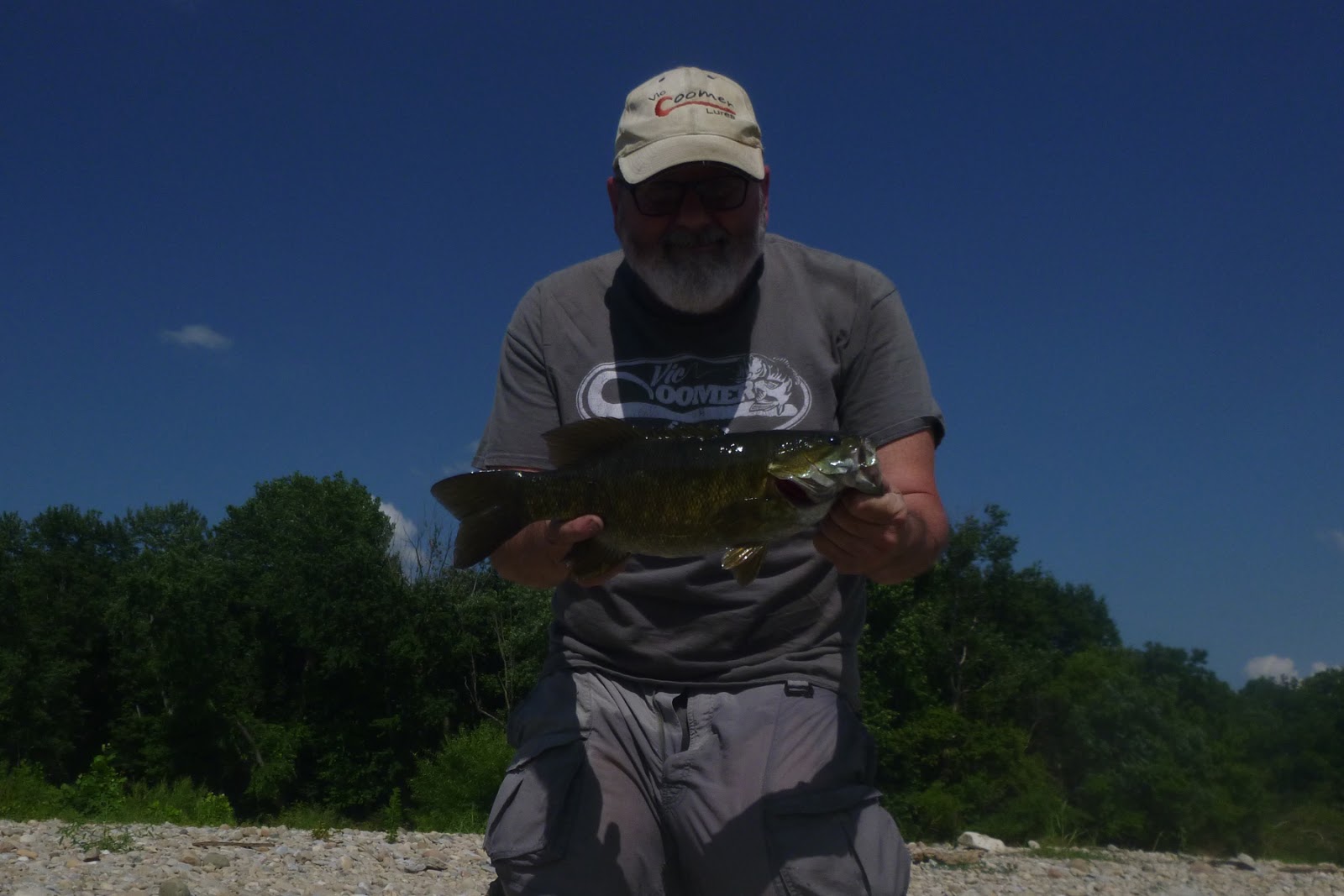
Tap and I set the hook and all H#@ broke loose. It was a huge smallie in the 19 to 20 inch range that went bat crazy on the short line. I had it on at least a minute and two jumps. I lifted the rod high pulling the fish towards me to lip it and it made a mad dash and swam right between my legs and then off to one side entangling me in the line as well. I'm in a bit over knee deep and trying to raise me leg and using me left hand to free the line and the fish made another dash and pop went the brand new 8lb test and it was gone! What a fish, I'll be back here for sure! I fished for about another half hour catching a small channel on the electric blue grub and then landed a swell smallmouth. While not as big as the one that got away (they never are, are they?) it was a great consolation prize and seemed like a good fish to end on if I was going to get back home before it hit 95...


Tap and I set the hook and all H#@ broke loose. It was a huge smallie in the 19 to 20 inch range that went bat crazy on the short line. I had it on at least a minute and two jumps. I lifted the rod high pulling the fish towards me to lip it and it made a mad dash and swam right between my legs and then off to one side entangling me in the line as well. I'm in a bit over knee deep and trying to raise me leg and using me left hand to free the line and the fish made another dash and pop went the brand new 8lb test and it was gone! What a fish, I'll be back here for sure! I fished for about another half hour catching a small channel on the electric blue grub and then landed a swell smallmouth. While not as big as the one that got away (they never are, are they?) it was a great consolation prize and seemed like a good fish to end on if I was going to get back home before it hit 95...


Subscribe to:
Posts (Atom)